How our sessions are structured
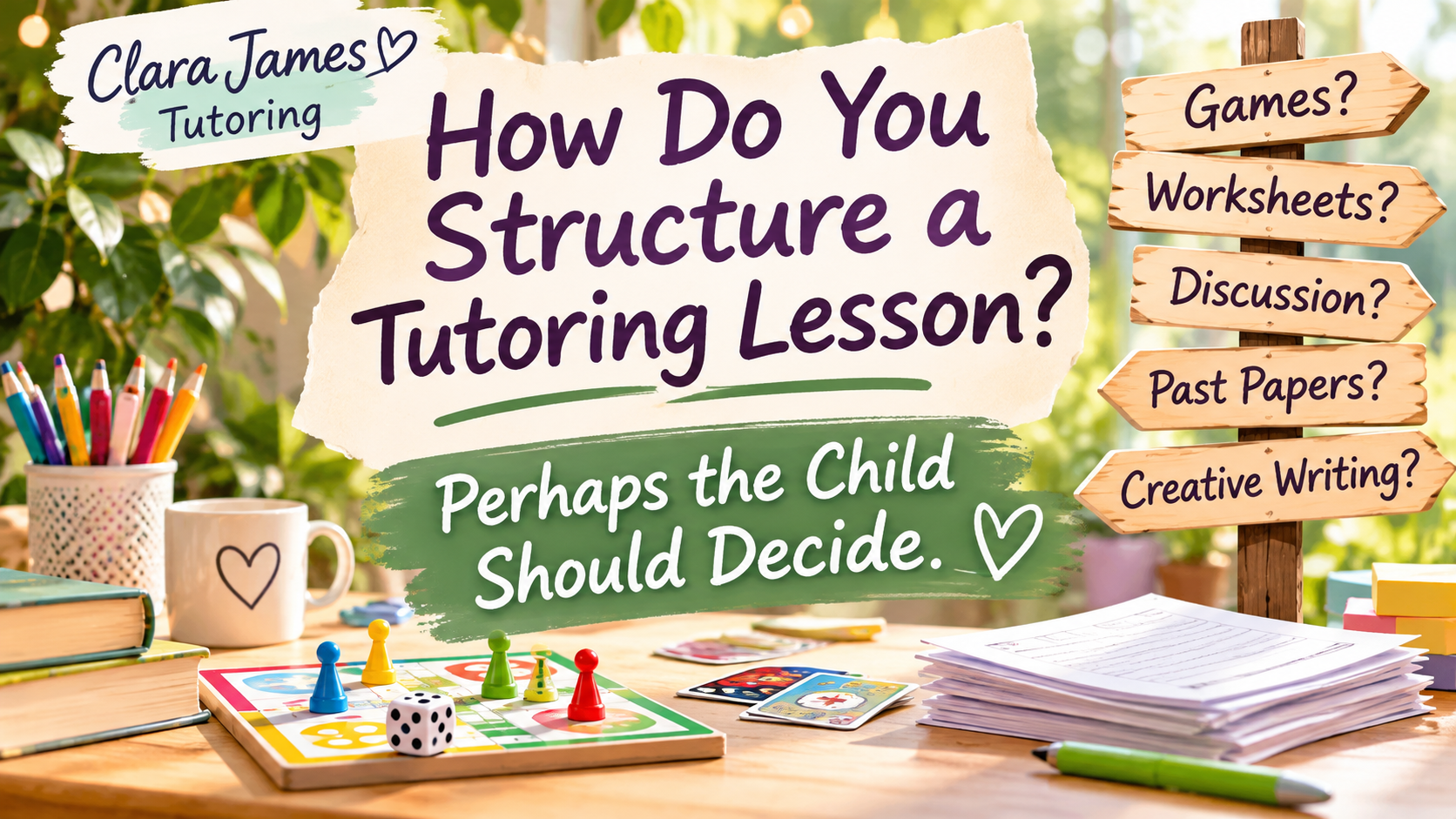
How Do You Structure a Tutoring Lesson? Perhaps the Child Should Decide.
Why giving children a little ownership of their learning can make such a difference.
Over the past 14 years of tutoring, I've learnt an awful lot. Some things have worked brilliantly, others haven't worked quite as I'd hoped, and there have been plenty of occasions when I've had to rethink what I was doing.
But one of the most valuable things I've learnt is that when it comes to structuring a tutoring lesson, sometimes the best approach is not to structure it too rigidly at all.
Now, that doesn't mean turning up without a plan, or simply hoping that something useful will happen!
Quite the opposite, actually.
It means arriving prepared, with plenty of ideas and resources, but being willing to let the child sitting in front of you have a say in what happens next.
Because, ultimately, they're the person we're there to support.
It starts before the first lesson
Whenever I meet a child for the first time, I've already had a conversation with their parents about what they'd like us to focus on.
It might be fractions, creative writing, spelling, GCSE revision or something completely different.
That gives me a starting point.
I'll then gather a selection of resources that we could use during our session.
Depending on the child's age and what we're covering, that might include games, worksheets, past papers, discussion prompts, mind maps or something more creative.
I like having options.
Because although I might have a good idea of what we're going to cover, I don't yet know how that particular child is going to enjoy learning it.
And that's quite an important distinction.
The first lesson is about getting to know each other
When we sit down together for the first time, I'll introduce myself, have a little chat and explain what I've brought along.
I'll also explain that this first lesson is an opportunity for us both to discover what works.
I might say something along the lines of:
"I've brought a few different things for us to try today. Some are games, some are worksheets, and some involve chatting through ideas. You might find some things too easy, some too difficult, or you might decide you simply don't enjoy learning that way. That's absolutely fine. Just tell me, and we'll try something different."
I want the child to understand from the beginning that there isn't a right or wrong answer when it comes to expressing their preferences.
They're not going to upset me by saying they don't enjoy a particular activity.
In fact, I'd much rather they told me!
And I'll remind them of that again at the end of the session.
If something hasn't worked, they can tell me directly or ask their parents to pass the message on.
It's not a criticism. It's useful information that helps me do my job better.
Two children, two completely different approaches
Let me give you a couple of examples.
I currently work with a lad who absolutely loves Ludo and Top Trumps.
In fact, he's quite happy to tell me that those are the activities he'd like to do every week.
So that's what we do.
I take along different versions of the games, adapting them to whatever we're working on.
He has mock exams coming up, so we might spend 20 minutes looking at a past paper to identify the areas he needs to practise.
Then I'll use that information to create the games we'll play during our next session.
We're still covering the relevant material. We're still working towards his exams.
But we're doing it in a way that he finds enjoyable and helpful.
He's told me himself that he learns far more from the repetition involved in playing games than he does from sitting and working through past papers.
So why would I insist on spending every lesson doing past papers?
Now, compare that with another student I've been working with for around 18 months.
I think we've probably played one or two games in all that time.
She loves worksheets and past papers.
She enjoys challenging herself, working through questions and gradually increasing the difficulty.
That's what motivates her.
And that's absolutely fine too.
Neither child is learning in a better or worse way.
They're simply different people with different preferences.
My job is to recognise that and respond accordingly.
Giving children a choice doesn't mean abandoning the learning
I think this is an important point.
When I talk about letting children choose how they'd like to structure their lessons, I'm not suggesting that we forget what they're supposed to be learning.
I'm suggesting that we give them some ownership over how we approach it.
For example, if we're working on English, I might arrive with a grammar game, a creative writing activity and a worksheet.
If we're looking at GCSE literature, we might have a past-paper question, a character-based game, some discussion prompts or an extract that we can read and annotate together.
All of those activities can support the same overall learning goal.
But the experience of completing them can feel very different.
Sometimes the child will choose something that I wouldn't necessarily have expected.
And sometimes that choice will tell me far more about how to support them than any initial assessment could.
What happens when something isn't working?
We change it.
It really can be that simple.
If a child is struggling to understand something, we can try explaining it differently.
If they're finding an activity frustrating, we can use another resource.
If they need to talk through their thoughts before writing them down, we can make time for that.
If they'd rather work quietly and independently, we can respect that too.
Of course, there will be times when we need to encourage a child to try something outside their comfort zone.
There will also be skills they need to develop, even if those skills aren't their favourite.
But we can approach those situations with encouragement, flexibility and a little creativity.
We don't have to make every lesson a battle.
And we certainly don't need to assume that because an approach worked brilliantly with one child, it will work equally well with the next.
Perhaps we should ask children more often
I wonder how frequently we actually ask children how they'd prefer to learn.
Not what subject they want to cover, or what grade they're hoping to achieve.
But how they'd like to approach the learning itself.
Would they rather talk something through?
Play a game?
Work independently?
Make a mind map?
Complete a worksheet?
Read together?
Sometimes we spend so much time deciding what children need that we forget to ask for their input.
And yet they're often very good at telling us what helps them, particularly when they feel comfortable enough to be honest.
It doesn't mean they'll always know exactly what they need.
That's where our experience and guidance come in.
But their opinions are valuable, and listening to them helps us build a relationship where learning becomes something we're doing together, rather than something being done to them.
So, how should you structure a tutoring lesson?
My suggestion would be to start with a learning goal, prepare a range of resources and then give the child some choice.
Find out what they enjoy.
Notice what helps them understand.
Listen when they tell you something isn't working.
And don't be afraid to change your plans.
Over the years, I've found that some of the most productive lessons have been the ones that haven't followed the structure I originally imagined.
Not because I wasn't prepared, but because I was prepared to adapt.
And I think there's a difference.
At Clara James Tutoring, one of the things I believe most strongly is that we should tutor the child, not the label.
Every child comes to us with their own experiences, interests, strengths, challenges and ideas.
Our role isn't to make them all learn in exactly the same way.
It's to help each of them discover what works for them.
And sometimes, the best place to start is with one very simple question:
"Where would you like to begin?"